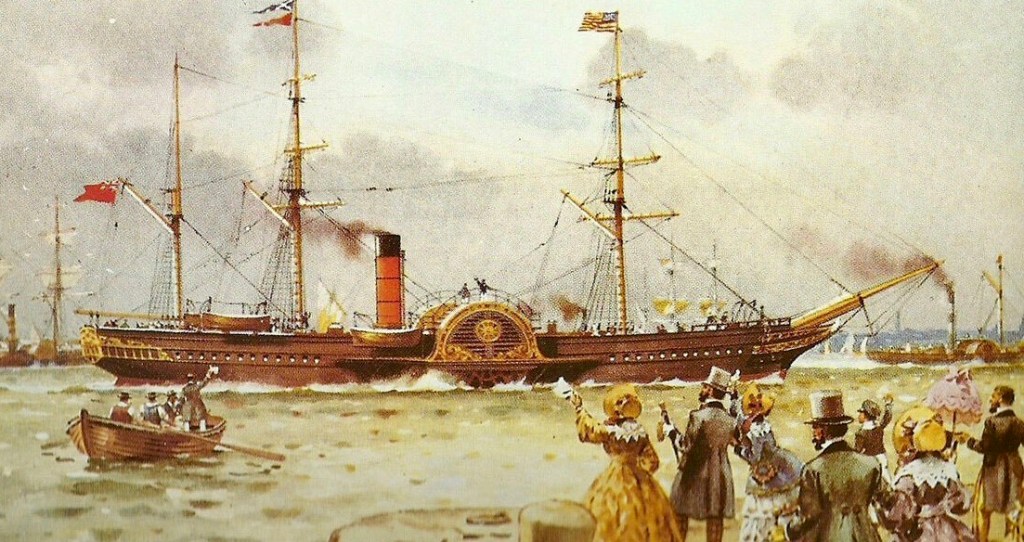
On 4 January 1842, Charles Dickens left Liverpool with his wife and her companion on the RMS Britannia. The Britannia was the flagship of the embryonic Cunard Line. She was build in Greenock, Scotland in 1840 and was the first of four paddle steamers of this class. The Arcadia, the Caledonia and Columbia soon followed. They were wooden paddle ships with three masts, and were effectively scaled down versions of the Great Western in design.
The Cunard Line were initially the only regular year long transatlantic passenger ships, and were sustained by the contract with the Admiralty to provide a Mail Service. They ran a fortnightly trip that reduced in the winter to monthly. However, this greatly reduced the passenger size of the ships, as the cargo space was largely taken up with coal and post. They were just over 200 feet at 63 metres, with a tonnage of 1,150 GRT, and averaged 9.5 knots.
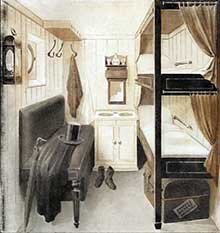
The Britannia Class could carry 115 passengers in a single class, with 80 sailors. There was one long deck house which served as a dining room, and the only other public room was a small Ladies Room. Also on deck was the housing for the cow, and with upside down boats covering the store of vegetables. The cabins were very small, rectangular rooms with space for two berths, one on top of the other, like bunk beds.
Charles Dickens was very keen to visit the newly formed Republic, and was championed by Washington Irving to do so. He also committed to writing a journal of his travels, so set off from Liverpool in January 1842 with high hopes. His first disappointment was the voyage!
Having had a relatively mild winter, the storms in the Atlantic hit the first voyage of the year hard. Dickens had already described the cabin as like a coffin, and was finding the turbulence hard to manage. He had attempted to soothe his wife who was feeling unwell with a glass of brandy with warm water. Unfortunately he was thrown around so much that he was unable to reach her without spilling it. This was a manifestation of how difficult he found the journey.
The ship arrived at 5pm on 22 January, at Boston’s Long Wharf. Charles Dickens was very well received in Boston from that first moment when the Britannia was swamped by the press and fans before they could disembark. His friends and supporters were able to ensure his party were able to safely travel to Tremont House where they were lodged.
Boston, the flashpoint of the American Revolution had become a cultural centre, with a well known university, two newspapers and theatres. Dicken’s writings were well read, because they were printed freely in America without the restraints of copyright. This became the focus of conflict when Dickens spoke out publicly about the needs of authors to be paid for their work. He urged the United States to join the Copyright Convention based in Europe, which the newly triumphant revolutionaries greeted with massive hostility. Dickens was then branded as greedy and money grasping.
For the next few months, Dickens toured the United States finishing in Halifax on 7 June, 1842. He had arrived with great enthusiasm about visiting an emerging democracy. As a committed social justice campaigner he had high hopes of a finding a more egalitarian society.
Sadly he was disappointed during his travels. Dickens spoke out publicly about his abhorrence of slavery, white collusion and the violent treatment of slaves. This continued to impact negatively on public perception of him, and although heartily welcomed within the literary circles, he found himself increasingly unhappy on his tour. The constant intrusion of the press, the violence and lack of respect for others, and individual greed wore him down.
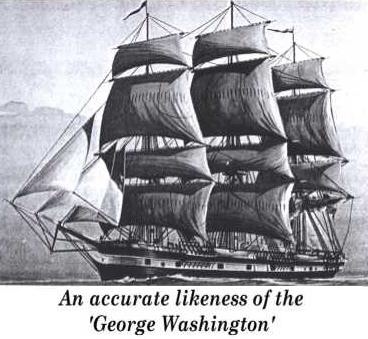
When he finally left the shores, he had determined to never repeat his experience aboard the Britannia. So they sailed back to England on an American packet sailing vessel, the George Washington, a three masted ship with ample provision for passengers. They landed in Liverpool on June 29.
Once home, Dickens spent the next four months writing the journal of his travels. The initial voyage was taken with such high hopes and anticipation of the great adventure ahead. He found it to be an uncomfortable ordeal. The travels in North America were proved to be a disappointment. He returned in 1867 post Civil War and stayed for five months on a reading tour. He was much happier, and reconciled with his fans and public. The purpose of the trip was financial, and it exceeded his expectations, which may well have helped.
His written account of the first trip, Notes for General Circulation, can be found on Gutenberg free online book resource. https://www.gutenberg.org/files/675/675-h/675-h.htm
Further reading can be found on the The Victorian Web, https://victorianweb.org/authors/dickens/boston.html and The Charles Dickens Page, https://www.charlesdickenspage.com/sailing-1842.html
 Julie Newman, visual artist
Leave a comment