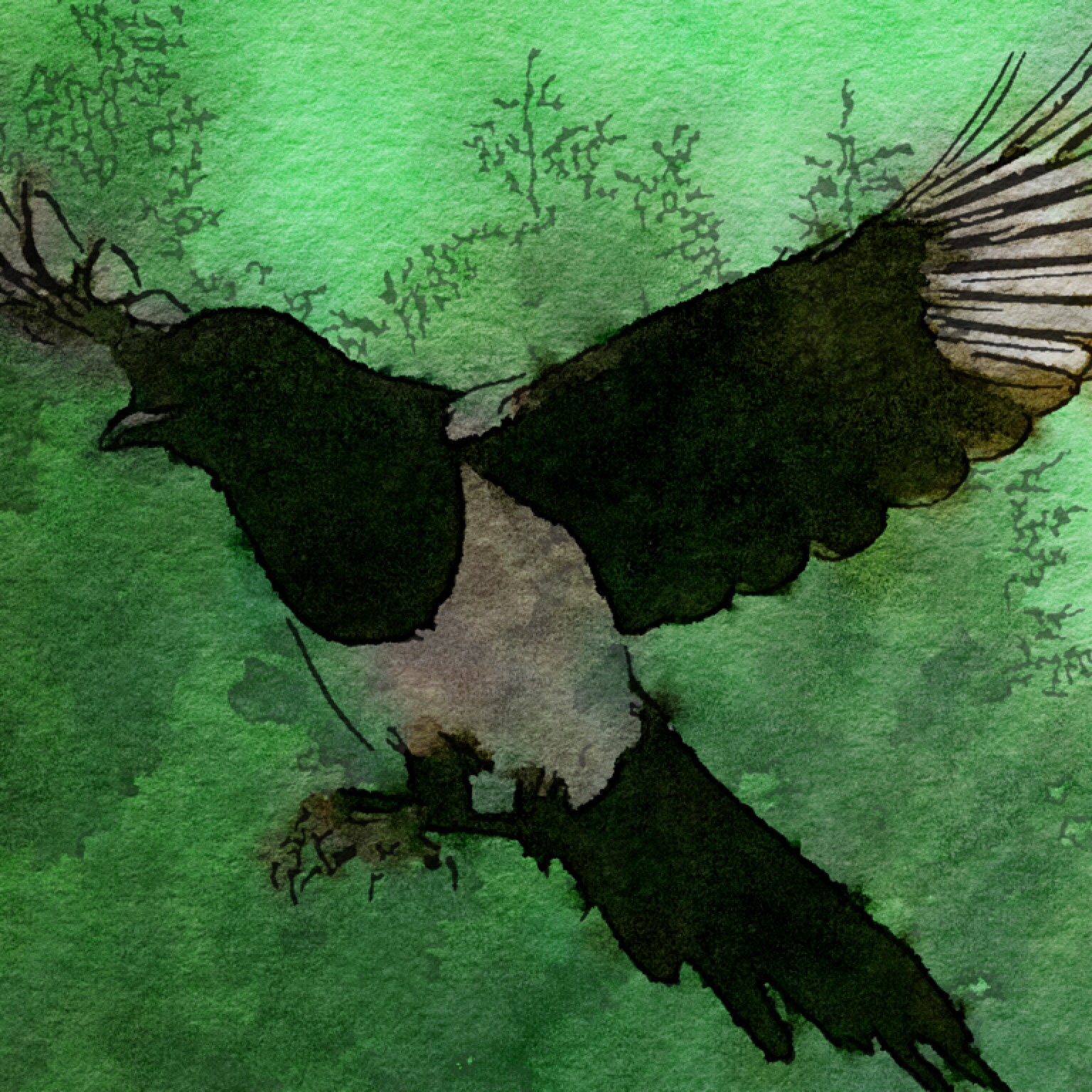
This morning I heard a magpie shout…
Raucous and loud, chattering in rhythms of eight…
And thought of my Mother…
Her eyes narrowed as she looked about…
Searching it out…
She peered around for the source of troubles untold…
But those that are about to unfold
On her unsuspecting family…
The Common Magpie, or Pica pica, is a member of the crow family, Corvidae or corvids, highly intelligent omnivores and capable of using tools. There are twenty species worldwide. They tend to be monogamous and have been reported to feel grief. They are quite large birds, up to 18 inches long, with a wingspan of up to two feet. Magpies are classically dominantly black and white, with the black glossy and showing a sheen of green and violet on the head and body, and with a sheen of green and purple on the wings, and green and reddish brown on the tails. The ‘mag’ is commonly thought as derivative from Margaret, Mags which is representative of women who are supposed to chatter, one of the sounds made the bird, and the ‘pie’ or ‘pied’ denotes two colours. Another name is ‘Treepie’.
In folk lore these birds serve as omens of ill fortune, and portenders of doom. They are regarded as thieves, attracted to shiny, sparkly items….hence The Thieving Magpie (La Grazza Ladra) by Rossini. Although modern research has demonstrated this to be untrue, the stories go back through time. The negative regard with which they are held has continued, with Magpies being thought to kill garden birds, and on farms to kill young lambs by pecking out their eyes. Garden birds are more vulnerable to cats than Magpies, and if young lambs die in the fields, then the birds will act on their omnivorous nature, and peck at the carrion. In North Wales older farmers will nail the bodies of dead Magpies with wings outstretched to the barns to ward off other Magpies.
The sight of one Magpie invokes a response of ‘Good morning Mr Magpie, how is your wife?’ followed by a spit. This reflects the belief that one Magpie brings sorrow and bad luck. There are versions of a saying, One for sorrow, two for joy, three a girl, four a boy, five for silver, six for gold, seven for a secret never told, eight for a wish, nine for a kiss, ten for a surprise be careful not to miss, eleven for health, twelve for wealth, thirteen beware it’s the devil himself. The Magpie is reputed to have stood alone while the other birds wept and sang to provide comfort to Christ during the Crucifixion, and so is cursed.
In Ireland, the Magpie is associated with the English arriving in the same county, not having been native but thought to have been blown across the Irish Sea 1682 and seen in Wexford by a Colonel in Cromwell’s army. He reported that the Irish maintained that they ‘shall never be free of the English while the Magpies remain’.
In another biblical reference, the. Magpie refused to go into the Ark instead choosing to sit on the roof during the flood. These leads to a belief that one Magpie sitting on the roof of a house shows that the house is strong and can sustain against bad weather, however there are some that think that someone inside will die. Such confusion of intent increases around the world. Some cultures believe that the Magpie is positive and the bird brings good luck and joy, and some First Nation tribes regard it as having strong shamanic properties. Shamanic symbolism associates the Magpie with the equinoxes balance of light and dark, thus Spring and Autumn and Yin and Yang.
Altogether the Magpie invokes confused response, but inevitably a response of some description…it rarely goes un-noticed.
 Julie Newman, visual artist
Leave a comment